Do you feel like you are typing brilliant ideas into ChatGPT or Claude, only to receive generic, robotic, or completely inaccurate responses in return? You are not alone. Learning how to write prompts effectively is the single most important skill for getting high-quality results from artificial intelligence. If your instructions are vague, the outputs will be too. This phenomenon, known as “AI hallucination,” occurs when a large language model confidently makes up facts when it lacks structured guidance. The good news is that you don’t need a computer science degree to learn how to write prompts like a professional engineer. Think of AI tools not as all-knowing supercomputers, but as fast junior interns: they need specific context, clear roles, defined boundaries, and structured workflows. If you want to compare how different platforms handle these instructions, check out our detailed comparison of ChatGPT Pro vs Claude Pro vs Perplexity Pro.
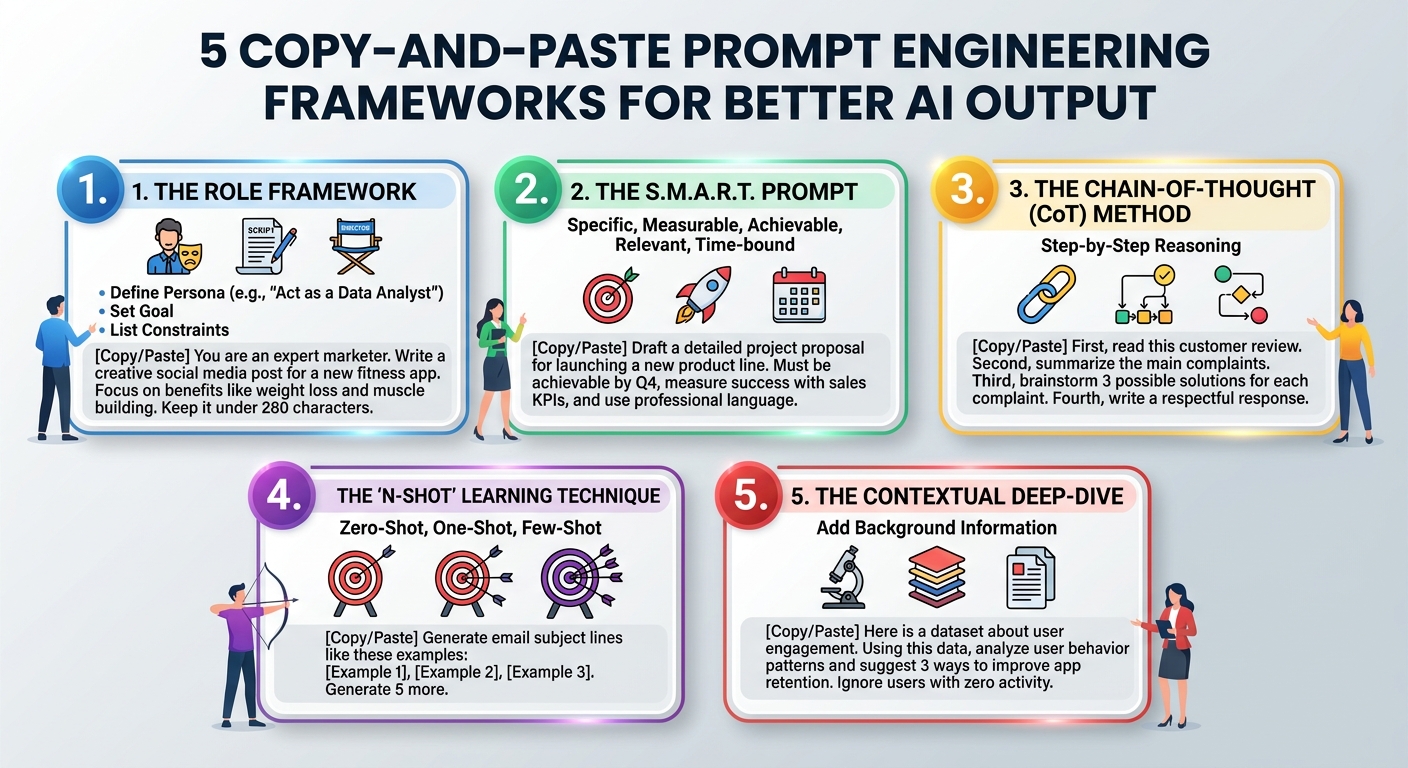
In this guide, we break down five actionable, repeatable prompt frameworks designed to eliminate fluff and force precise, high-value outputs:
- The Role Framework: Assign a specific persona (e.g., “Act as a Senior Financial Analyst”) before asking your core question.
- The S.M.A.R.T. Prompt: Ensure your request includes specific parameters, measurable metrics, and clear timeframes.
- Chain-of-Thought (CoT) Method: Ask the AI to reason through the problem step-by-step before giving a final answer.
- The ‘N-Shot’ Technique: Provide 2–3 concrete examples of your desired output style within the prompt itself.
- Contextual Deep-Dive: Paste relevant background data or source documents directly into the chat session.
Whether you are automating a marketing campaign or drafting complex reports, mastering how to write prompts using these copy-and-paste templates will transform your daily workflow. For further technical documentation on language model capabilities, read the official guidance from OpenAI’s Prompt Engineering Guide.